Monday, 16 April 2012

Kitply Plywood

Plywood is probably the most popular, versatile, strong and flexible man-made woodworking material used for building furniture and cabinetry. Plywood is a laminated product made up of numerous thin strips of wood laid in alternating directions and bonded with glue into strong, stable sheets. Because of the way in which plywood is constructed, it also resists cracking, bending, warping, and shrinkage, depending upon its thickness. Kitply is among the first Indian companies to include commitment to environmental protection as one of its corporate objectives. Tree plantation is a regular and committed activity at Kitply spread over an area of 1000 acres in factories and residential townships. Kitply Industries has the following Environmental Policy: Through its endeavors to develop more effective ways and methods to conserve our natural resources, Kitply Industries is determined to fulfill its responsibility of beautifying and protecting the natural ambience that surrounds us by enhancing the awareness of its employees. Kitply Industries conserve energy and resources in all its activities. It promotes the development of products and technologies that minimize environmental impact, while at the same time taking into account the maintenance of people's safety and health. It strives to safeguard the safety and health of local citizens, together with those of its employees.
Production of tree crop on degraded wasteland successfully was its main objective to take up Agro Forestry Project in 1994 (around Raipur of Madhya Pradesh now known as Chhatisgarh).
The Agro Forestry Project shall:
     · Create massive employment opportunities among the rural poor.
     · Reduce pressure on natural forests for fuel, fodder and commercial timber.
     · Prevent top soil erosion, improve water holding capacity of the soil and recharge underground water and provide clean environment.
     · Utilize hazardous industrial waste such as fly ash and sewage sludge for development of waste lands

National Mineral Development Corporation

Since its inception, the National Mineral Development Corporation has been involved in the exploration of wide range of minerals including iron ore, copper, rock phosphate, lime stone, dolomite, gypsum, bentonite, magnesite, diamond, tin, tungsten, graphite, beach sands etc. They have a strict corporate policy for environmental management. They intend to:
1) Create sound and eco-friendly environment for sustainable development at all production projects
2) Plan new projects with environment – friendly considerations
3) Plan regulative, ameliorative and mitigative measures to protect environment
4) Lend support to projects on environmental matters
The Environmental Policy is framed specifically to fulfill the following objectives:

1) Create a work environment which enhances/ motivates production and productivity.
2) Create a residing environment for the enjoyment & peace of employee.
3) Encourage safe and scientific mining and other engineering practices.
4) Promoting awareness amongst the employees and the neighbourhood population for adopting environmentally acceptable procedures and restricting environmental degradation and pollution to the barest minimum.
5) Establishing "Eco-label" for its finished products so as to promote domestic and international markets.
6) To achieve Communal harmony and peace amongst the employees and the local villagers for heading fast towards "sustainable development".
7) Meaningful use of forest lands within the lease areas.
8) Restoration of the post mining land use to the pre-mining status, to the extent possible.
NMDC has specially appointed officers to monitor the environmental performances and guide the Projects for maintaining good environmental practices and to adopt newer, safe and cleaner technologies. They also started afforestation on a planned pattern in consultation with Divisional Forest Officer (Social forestry) of concerned areas with the objectives such as increasing the density around the project & township, stabilization of degraded lands & waste dumps for preventing soil erosion, rehabilitated of mined out areas, improving the condition of the catchment areas and stream courses and aesthetic look of the township areas.

Sunday, 15 April 2012

STRUCTURE OF THE ENVIRONMENT

Environment, Ecology and Ecosystem are three different terms. But they are interrelated. The natural surroundings of an organism, both living and physical is its environment. The physical component consists of air, water, light, land etc. The biotic component consists off all the living organisms surrounding us. Scientists believe that natural environment is a better word to use given the common use of the word environment. Ecology is a branch of study of the interrelationships with the organism and its environment. It is a basic fact that the Earth includes a large variety of living things which depend in some way on other living and non-living things. This study of how the existence and activity of organism influences its environment and the vice versa is ecology. Ecology involves collecting information about organisms and their environment, looking for patterns, and seeking to explain these patterns. The ecology that takes place in a defined area is called ecosystem. Ecosystem is a functional unit of dynamic system of organisms interacting with each other (biotic) and the inanimate environment (abiotic).

The structure of the environment can be depicted as follows:


All components of environment are closely related and interact with each other.

Though air, water and land are the components of environment, the Britishand American scientists put in two different manners.

1.Components of Environment as per British literature

Here the components are classified in terms of biotic and abiotic based uponlife. The biotic components are further listed as producers, consumers anddecomposers and the abiotic components are classified as climatic(water, air)and edaphic(land). It is from this component system that the study of structureof ecosystem was evolved.
The biotic components of an ecosystem are the living organisms that exist in the system. These organisms can be classified as producers, consumers or decomposers. Green plants prepare complex organic food using abiotic factors like carbon dioxide and water in the presence of sunlight by a process vital to survival of life on earth – Photosynthesis. Green plants are used by herbivores and the herbivores are in turn consumed by carnivores (secondary consumers) which are then consumed by tertiary consumers which constitutes what is known as food chain. Thus all living beings obtain food from plants directly or indirectly. After the death of all these organisms, decomposers decompose complex organic substances of their body into simple inorganic forms. These are again absorbed by the green plants and this forms a cycle.
The abiotic components of an ecosystem are the non-living features of the ecosystem that the living organisms depend on. Each abiotic component influences the number and variety of plants that grow in an ecosystem, which in turn has an influence on the variety of animals that live there. The way in which plants and animals grow and carry out their different activities is a result of several abiotic factors. These factors are light, temperature, water, atmospheric gases, wind as well as soil (edaphic) and physiographic (nature of land surface) factors. Light energy (sunlight) is the primary source of energy in nearly all ecosystems. It is the energy that is used by green plants (which contain chlorophyll) during the process of photosynthesis The distribution of plants and animals is also greatly influenced by extremes in temperature for instance the warm season. The occurrence or non-occurrence of frost is a particularly important determinant of plant distribution since many plants cannot prevent their tissues from freezing or survive the freezing and thawing processes. In animals, a distinction is made between ectothermic ("cold-blooded" or poikilothermic) animals and endothermic ("warm-blooded" or homothermic) animals. Plant and animal habitats vary from entirely aquatic environments to very dry deserts. Water, which forms the hydrosphere, is essential for life and all organisms depend on it to survive especially in desert areas. The atmosphere also plays a critical role in sustaining life on earth. The most important gases used by plants and animals are oxygen, which is used by all living organisms during respiration, carbon dioxide, which is used by green plants during photosynthesis and nitrogen, made available to plants by certain bacteria and through the action of lightning. Winds or air currents arise on a world-wide scale as a result of a complex interaction between hot air expanding and rising (convection) in the mid-latitudes. This has various effects on the rotation of the earth and results in a centrifugal force which tends to lift the air at the equator. This force is known as the Coriolis force and tends to deflect winds to their left of the southern hemisphere and to the right in the northern hemisphere. Winds carry water vapour which may condense and fall in the form of rain, snow or hail. Wind plays a role in pollination and seed dispersal of some plants, as well as the dispersal of some animals, such as insects. Soil (edaphic factors) factors include soil texture, soil air, soil temperature, soil water, soil solution and pH, together with soil organisms and decaying matter which plays a major role in helping plant growth as well as in providing an environment for sub-terrestrial animals. Lastly, physiographic factors refer to the factors that are those associated with the physical nature of the area, such as altitude, slope of land and the position of the area in relation to the sun or rain-bearing winds. Altitude plays a role in vegetations zones. Slopes are important when considering the temperature of the soil surface on land with a northern slope, on level and on land with south facing slopes.

2.Components of Environment as per American literature
As per American literature, the components of environment are listed as:
1.Hydrosphere(Water)
2.Atmosphere(Air)
3.Lithosphere(Land)
4.Biosphere(Flora/Fauna/Microbes)
5.Anthrosphere (man made things)

Hydrosphere:

The hydrosphere contains all the solid, liquid, and gaseous water of the planet. It ranges from 10 to 20 kilometers in thickness. The hydrosphere extends from Earth's surface downward several kilometers into the lithosphere and upward about 12 kilometers into the atmosphere. A small portion of the water in the hydrosphere is fresh (non-salty). This water flows as precipitation from the atmosphere down to Earth's surface, as rivers and streams along Earth's surface, and as groundwater beneath Earth's surface. Most of Earth's fresh water, however, is frozen. Ninety-seven percent of Earth's water is salty. The salty water collects in deep valleys along Earth's surface. These large collections of salty water are referred to as oceans. The image above depicts the different temperatures one would find on oceans' surfaces. Water near the poles is very cold, while water near the equator is very warm. The differences in temperature cause water to change physical states. Extremely low temperatures like those found at the poles cause water to freeze into a solid such as a polar icecap, a glacier, or an iceberg. Extremely high temperatures like those found at the equator cause water to evaporate into a gas. Some scientists place frozen water--glaciers, icecaps, and icebergs--in its own sphere called the "cryosphere." For the purpose of this module, however, frozen water will be included as part of the hydrosphere. The word "hydrosphere" will be used in reference to all water in Earth's system. 

Atmosphere:

 
The atmosphere contains all the air in Earth's system. It extends from less than 1 m below the planet's surface to more than 10,000 km above the planet's surface. The upper portion of the atmosphere protects the organisms of the biosphere from the sun's ultraviolet radiation. It also absorbs and emits heat. When air temperature in the lower portion of this sphere changes, weather occurs. As air in the lower atmosphere is heated or cooled, it moves around the planet. The result can be as simple as a breeze or as complex as a tornado. The atmosphere is made up of many layers namely the toposphere, stratosphere, mesosphere, thermosphere and exosphere.

Lithosphere:

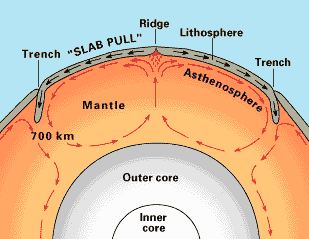
The lithosphere contains all of the cold, hard solid land of the planet's crust (surface), the semi-solid land underneath the crust, and the liquid land near the center of the planet. The surface of the lithosphere is very uneven. There are high mountain ranges like the Rockies and Andes, huge plains or flat areas like those in Texas, Iowa, and Brazil, and deep valleys along the ocean floor. The solid, semi-solid, and liquid land of the lithosphere form layers that are physically and chemically different. The outermost layer of the lithosphere consists of loose soil rich in nutrients, oxygen, and silicon. Beneath that layer lies a very thin, solid crust of oxygen and silicon. Next is a thick, semi-solid mantle of oxygen, silicon, iron, and magnesium. Below that is a liquid outer core of nickel and iron. At the center of Earth is a solid inner core of nickel and iron. The word "lithosphere" can take on different meanings depending on the speaker and the audience. For example, many geologists--scientists who study the geologic formations of Earth--reserve the word "lithosphere" to mean only the cold, hard surface of Earth, not the entire inside of the planet.

Biosphere:


The biosphere contains all the planet's living things. This sphere includes al\l of the microorganisms, plants, and animals of Earth. Within the biosphere, living things form ecological communities based on the physical surroundings of an area. These communities are referred to as biomes. Deserts, grasslands, and tropical rainforests are three of the many types of biomes that exist within the biosphere. It is impossible to detect from space each individual organism within the biosphere. However, biomes can be seen from space. For example, the image above distinguishes between lands covered with plants and those that are not. Some scientists place humans in their own sphere called the "anthrosphere."

All these physical and biological factors working in tandem with cultural, social, economic and other man-made elements provide a suitable environment for sustenance of all life-forms. The manner in which they interact with each other plays a crucial role in maintaining an ecological balance.

Sources:
http://www.cotf.edu/ete/ESS/ESSspheres.html
http://www.bcb.uwc.ac.za/Sci_Ed/grade10/ecology/abiotic/abiot.htm

DROUGHT

Drought is a period or condition of unusually dry weather within a geographic area where rainfall is normally present. Droughts occur in all climatic zones. However, its characteristics vary significantly from one region to another. Drought usually results in a water shortage that seriously interferes with human activity. Water-supply reservoirs empty, wells dry up, and crop damage ensues. Its seriousness depends on the degree of the water shortage, size of area affected, and the duration and warmth of the dry period.

CAUSES

      1. Water vapor condenses only if air rises into the colder regions of the atmosphere. If the air doesn’t rise, then no rain will form. When there is high air pressure, air falls instead of rising. With the air pressing down in a high pressure zone, no currents of water vapor are carried upward. As a result, no condensation occurs, and little rain falls to earth.
      2. Most precipitation depends on water vapor carried by winds from an ocean or other source of moisture. If these moisture-carrying winds are replaced by winds from a dry region or flow in different directions, the weather is abnormally dry and often persistently cloudless.
      3. Mountains can prevent wind from blowing moisture to needed regions. As air is moving past a mountain range, it is forced to rise in order to pass over the peaks. However, as the air rises, it becomes colder and the vapor condenses into rain or snow. The rain then falls on that side of the mountain, known as the windward side (the side that is turned toward the wind). When the air mass finally makes it over the mountain, it has lost much of its vapor. This is another reason why many deserts are found on the side of a mountain facing away from the ocean. This phenomenon is known as the rain shadow effect.


IMPACTS 


a) Environmental: - Some direct impacts of drought are reduced crop and forest productivity, reduced ground water levels, increased fire hazard, increased livestock and wildlife death rates, and damage to wildlife and fish habitat. Drought is also associated with increases in insect infestations and plant disease. Forest fires increase dramatically during periods of droughts. 
b) Economic: - A reduction in crop productivity usually results in less income for farmers, increased prices for food, unemployment, and migration. 
c) Social: - Social impacts include health, public safety, conflicts between water users, and reduced quality of life. During droughts many people migrate to areas outside the drought-affected location. When this happens, the area loses a great deal of its population, and thus the area has less financial support. Between 1950 and 1980 the drought of Brazil had a loss of 5.5 million people. This continues to be a significant problem in the economic development of Brazil.


WARNING AND DISSEMINATION


There is a "Weather-Watch-Group" in the Ministry of Agriculture, which meets every week to take stock of the rainfall progress, its effects on the crops from sowing to harvesting, during the kharif season. Weekly input gives an early warning about the impending drought as and when symptoms arise in this regard and the states are warned accordingly. The drought assessment is based on a comparative evaluation of satellite observed green vegetation cover (both area and greenness) of a district in any specific time period, with that of any similar period in previous years.


PREVENTION


Although drought cannot be reliably predicted, certain precautions can be taken in drought-risk areas. It is important to develop strategies to protect from drought. Strategies for drought protection, mitigation or relief include:
1. Construction of Dams:
The construction of dams is a better choice to avoid drought. Dams work by storing the extra water when it is available, so that during a time of drought, it can be released. It is done both to prevent drought and to prevent flooding. The main purpose of most dams is to create a permanent reservoir of water for use at a later time. The dam must be watertight (i.e. impermeable or impervious to water) so that water does not leak out of the dam and escape downstream. An essential part of a dam is therefore the "impermeable membrane", i.e. the watertight part of the dam that prevents water leaking out.
2. Cloud seeding:
Cloud seeding is the process of spreading either dry ice, or more commonly, silver iodide aerosols, into the upper part of clouds to try to stimulate the precipitation process and form rain. Since most rainfall starts through the growth of ice crystals from super-cooled cloud droplets (droplets colder than the freezing point, 32 deg. F or 0 deg. C) in the upper parts of clouds, the silver iodide particles are meant to encourage the growth of new ice particles. The history of cloud seeding has experienced uncertain results because it can never be known whether a cloud that rains after seeding might have rained anyway. This is because seeding is performed on clouds that look like they have some potential for producing rain.
3. Desalination:
It is the process of removing soluble salts from water to render it suitable for drinking, irrigation, or industrial uses. The principal methods used for desalination include distillation (or evaporation), electro dialysis, freezing, ion exchange, and reverse osmosis.
4. Rainwater Harvesting:
Broadly rainwater can be harvested for two purposes
·                   Storing rainwater for ready use in containers above and below ground.
·                   Charged into soil for withdrawal later.
Rainwater harvesting can be harvested from the following surfaces 
               Roofftops.
                   Paved and unpaved areas.
·                  Water bodies.
                   Storm water drains.
The decision whether to store or recharge water depends on the rainfall pattern and the potential to do so, in a particular region. The sub-surface geology also plays an important role in making this decision.
5. Recycled water:
The use of recycled water in horticulture (urban and rural) and industry, as well as in residential areas has grown considerably over the past decade. Recycled water is water from the city or sewage that is then treated and reused. No potable water, not suited for drinking, is reused on a daily basis in some cities. It can be used for such things as car washes, laundry facilities, road cleaning, firefighting and toilet flushing. No potable water reuse is most beneficial in cities when irrigation is in full swing at ball fields, golf courses, parks, schoolyards and residential lawns. Using reclaimed water for irrigation has a marked difference on potable water levels during these months.
6. Other small scale methods:
a. Mulching
Mulches like UV stabilized poly-sheets have become the major input for growing crops. Such sheets reflect the sunlight and causes minimum soil moisture evaporation. Israel is the leading country adopting this method with very high productivity.
b. Coconut Compost
India has plenty of resources to tackle soil moisture retention like the coconut compost. When the coconut husk is composted and added to soil, the coconut fibre absorbs moisture from the soil and retails for a long period releasing moisture gradually to crops. This technology has made farming in drought prone areas very simple. Many coconut husk processing units in Tamil Nadu like Pollachi is taking advantage and exports several thousand tons of coconut compost to countries like Israel which uses as a media in green houses for growing roses, vegetables and fruits.
c. Water Aquifers
Water aquifers are made to recharge the ground water without wasting the rain water. Aquifers are simple methods of percolation by which small bore wells are dug and the inner surface is perforated and filled with gravel to absorb the rain water. The rain water percolates deep into the ground and recharges the ground water.


FAMOUS DROUGHTS
      
      1. When pione­ers headed west in the late 19th century, many couldn't resist the lure of the tall gras­sy land in the semiarid midwestern and southern plains of the United States. They settled there to farm. They were prosperous in the decades that followed, but when the 1930s rolled in, so did strong winds, drought and clouds of dust that plagued nearly 75 percent of the United States between 1931 and 1939 [source: PBS]. The era became known as the legendary Dust Bowl. The Dust Bowl brought ecological, economical and human misery to America during a time when it was already suffering under the Great Depression.
      
      2. There was a major drought in the Sahel, Africa in 1914, caused by annual rains far below average that caused a large-scale famine. As another long drought-period from 1968 through 1974 began, the grazing quickly became unsustainable, and large-scale denuding of the terrain followed. Like the drought in 1914, this led to a large-scale famine, but this time it was somewhat tempered by international visibility and an outpouring of aid. This catastrophe led to the founding of the International Fund for Agricultural Development. In June to August, 2010, famine struck the Sahel again. Niger's crops failed to mature in the heat, and famine occurred. 350,000 faced starvation, and 1,200,000 were at risk of famine.